
Supercharger

The Tesla Supercharger provids DC fast charging for properly equiped Tesla vehicles.


[top]Debut

The Tesla Supercharger made its public debut on Monday, September 24th, 2012 at the Tesla Design Studio in Hawthorne, CA.

[top]Features

The Supercharger can charge a Model S from empty to half-full in approximately 30 minutes.

Tesla have pledged to supply power equivalent to the total used for Supercharging from solar sources. In some cases, this is from a Solar Canopy above the charging points. In cases where the Solar Canopy cannot be provided (due to site constraints), Tesla have pledged to offset this from other locations.

The network is free of usage charges "for life", to suitably equipped Tesla vehicles (currently, all Model S 85kWh, and the Model S 60kWh if an additional fee has been paid at the time of purchase).

[top]Network

(See main article Tesla Supercharger locations.)

At launch, 6 locations were available in California.

[top]Technical Details

The supercharger uses the standard Model S charge connector, and uses the same two pins on the connector that normally deliver 240VAC (up to 80A) to instead deliver approximately 365VDC at up to 225A (when charging a 85kWh Model S). Hence when charging an 85kWh Model S the supercharger delivers around 80kW. The Supercharger is specified to deliver up to 120kW for future vehicles that can accept charge at that rate. The capability of the 60kWh Model S is not yet known, but has been stated by Tesla to be less than the 85kWh - on the assumption that it scales in proportion to the battery size, that would suggest approx 150A (55kW).

The rate of charge decreases as the charge progresses. Exact details are not yet known, but it is said to charge rapidly (constant rate?) to 'half' full, and then tail off to a slower rate as it approaches fully charged. One example shows a Model S 85kWh pack at 131 ideal miles (a little under half) still charging at 216A. Charging can be set in the car to 'standard' or 'range' mode. It is believed (but not confirmed) that the behaviour is the same as for normal AC charging: both modes follow the same charge profile up to 90% of full charge, at which point Standard mode stops charging while Range mode carries on to the maximum permitted level.

Superchargers are installed in pairs. Each pair is driven by a stack of standard Model S chargers (ie. the same 10kW charger unit that is installed in the car in single or dual configurations), arranged in groups of 3 such that they can be fed conveniently from 3-phase power. The stack contains either 12 or 9 chargers (for a total of 120 or 90kW) feeding the two charge cables. The power available from the chargers is distributed between the two cables according to demand: if two 85kWh cars, both empty, arrive at the same time then they will receive less than their ideal charging current. Ideal for the 80kWh car is 80kW, so they will get 75% or 56% of their ideal current (depending on number of chargers in the stack) and charge correspondingly more slowly. If the first car has already reached a substantial level of charge, or is a 65kWh model, then it will be drawing less than the maximum and so a greater proportion of the charger's capability can be directed to a newly-arrived car.

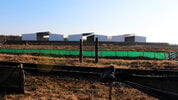
The smallest sites have just one supercharger stack (ie. charging spots for 2 cars). Larger sites have multiple charger stacks. Some sites appear to have been prepared with the civil engineering (parking places, conduit under the road surface, concrete base for the chargers) for multiple stacks but only equipped with one set of electronics initially. It also appears (eg. from looking at the Folsom site) that adjacent parking spots are not served from the same charger stack. Identifying which slot to pull into for maximum capacity will require further research.


Some form of signalling is provided for the car to control the charger behaviour. Details are not known. The connector is known to have pins for the SAE J1772 control pilot (for use with the passive J1772 plug adaptor): it is possible that these are re-purposed for Supercharger signalling. Alternatively, Tesla may be using powerline signalling (RF carrier over the DC power pins), as proposed for the SAE DC charging standard.

At the Folsom, CA site, supply from the grid is 500kVA at 12kV, from which a transformer supplies 3-phase at 480/277V to the Tesla equipment. It is speculated that the chargers are connected in a Y configuration to give 277V at the input of each charger.

Information from the rating plate on the Supercharger hardware at Harris Ranch (photo 2012-10-20 by DrComputer):
Supercharger 120
TPN 1020473-00-A
TSN 1210000007
Input Voltage 200-480VAC L-L
Input Current 280A @200-240VAC / 160A@480VAC
Phases 3PH+GND@200-240VAC / 3PH+N+GND@480VAC
Frequency 50/60Hz
Output Voltage 40-410VDC
Output Current 210A Max Continuous
Oper.Temperature -30C to 50C
Enclosure Type 3R/IP55
Weight 1320Lbs / 600Kg

[top]Access

So far, the only vehicles with access to the Superchargers are the 85 kWh Model S, 60 kWh Model S with the $2000 Supercharger option, and the Model X prototype.

(sources: video of launch event http://www.teslamotorsclub.com/showt...network/page65, NY times article http://www.nytimes.com/2012/09/30/au...he-future.html, photos of Folsom site under construction http://www.teslamotorsclub.com/showt...n-in-Folsom-CA, screen shots of charging in progress http://www.teslamotorsclub.com/showt...network/page67)

Page Information

Users Browsing this Page

There are currently 1 users browsing this page. (0 members and 1 guests)


Posting Permissions

Posting Permissions
  • You may not create new articles
  • You may not edit articles
  • You may not post comments
  • You may not post attachments
  • You may not edit your comments