
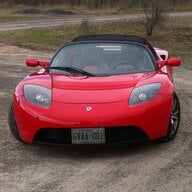
Today I had the summer tires put back on my Roadster (2.5 non-Sport). And boy, did the acceleration ever jump. It seemed to me that it was slower with the snow tires, and I always noticed the tc icon on the dashboard when I floored it, even when there was no slipperiness on the road. I thought the snow tires were supposed to be stickier. But now with the summer tires again, the tc icon is gone and I can feel that old acceleration that I remembered from last summer. So I guess on dry pavement the snow tires don't have as much traction. I suppose I shouldn't be surprised. Racing cars use slicks if the track is dry. I guess snow tires have less rubber on the road, in exchange for the ability to grip on snow.



Welcome to Tesla Motors Club
Discuss Tesla's Model S, Model 3, Model X, Model Y, Cybertruck, Roadster and More.
Register
Install the app
How to install the app on iOS
You can install our site as a web app on your iOS device by utilizing the Add to Home Screen feature in Safari. Please see this thread for more details on this.
Note: This feature may not be available in some browsers.
-
Want to remove ads? Register an account and login to see fewer ads, and become a Supporting Member to remove almost all ads.
You are using an out of date browser. It may not display this or other websites correctly.
You should upgrade or use an alternative browser.
You should upgrade or use an alternative browser.
Acceleration: Winter vs. Summer Tires.
- Thread starter daniel
- Start date
-
- Tags
- Performance Roadster


S-2000 Roadster
#1244
I drove from Seattle to Oakland and back on snow tires from the Tesla Store, and I did not see any additional TC. However, the car felt looser, and I'm sure I could feel a difference in stability - no doubt due to the taller tread with way more siping. I'm back on the standard tires now, but I don't regret having the snow tires for winter extremes.
Very odd. I certainly have no regrets about using snow tires in winter. It's a safety issue. I got the tires from Tesla, the ones they recommended for winter. But I have considerably more acceleration now that I'm back on the summer tires.
Yggdrasill
Active Member
It'll depend on a variety of factors. Winter tires suck at wet roads, for instance, and will water plane in an instant. Are you completely sure the road was absolutely dry?
Winter tires also use a rubber mixture intended for colder temperatures, which means that at higher temperatures they are stickier. This isn't necessarily a good thing, because you might just end up losing rubber instead of moving you forward. Too soft isn't any better than too hard.
(I just checked some tests done on winter tires - at 50 mph at 26 C, the braking distance was 14.5 meters/40 feet longer than at 6C. And at 60 mph in summer, the braking distance on dry asphalt was around 34 meters/100 feet longer than good summer tires. That says something on the amount of traction you've lost.)
Winter tires also use a rubber mixture intended for colder temperatures, which means that at higher temperatures they are stickier. This isn't necessarily a good thing, because you might just end up losing rubber instead of moving you forward. Too soft isn't any better than too hard.
(I just checked some tests done on winter tires - at 50 mph at 26 C, the braking distance was 14.5 meters/40 feet longer than at 6C. And at 60 mph in summer, the braking distance on dry asphalt was around 34 meters/100 feet longer than good summer tires. That says something on the amount of traction you've lost.)
djp
Model 3 Performance
I put my summer tires back on today. Both acceleration and handling are noticeably improved and the car is a lot more fun to drive - I was grinning all afternoon. I didn't see TC light up very often with the snows, but I think the deeper treads made the car feel more "squirmy" on fast starts and corners. It's nice to have my old Roadster back!
Me too. Beautiful warm day, more of the same forecast for the whole week, definitely time to switch back to summer tires! If we get a snowstorm I'll park the car for a day or two.
The car handles much better with the summer tires. Also nice to stop getting the TPMS failure messages every time I took the car out.
(Funny thing... sometimes when I started up in the garage I would get low tire pressure messages for my fronts. Those tires weren't on the car, they were on the tire rack! Of course I pumped them up when I reinstalled them.)
Man did this winter ever fizzle!
The car handles much better with the summer tires. Also nice to stop getting the TPMS failure messages every time I took the car out.
(Funny thing... sometimes when I started up in the garage I would get low tire pressure messages for my fronts. Those tires weren't on the car, they were on the tire rack! Of course I pumped them up when I reinstalled them.)
Man did this winter ever fizzle!

Jaff
Active Member
Same here (on Hankook's)...
I never have TC kick in when I'm straight-line accelerating with my Hankook winters ... Not that im recommending them (for other reasons).
Jaff
Active Member
Careful now Doug...we don't want to tempt fate...:biggrin:
(Got to admit though, I'm thinking along these lines as well.)
(Got to admit though, I'm thinking along these lines as well.)
Me too. Beautiful warm day, more of the same forecast for the whole week, definitely time to switch back to summer tires! If we get a snowstorm I'll park the car for a day or two.
The car handles much better with the summer tires. Also nice to stop getting the TPMS failure messages every time I took the car out.
(Funny thing... sometimes when I started up in the garage I would get low tire pressure messages for my fronts. Those tires weren't on the car, they were on the tire rack! Of course I pumped them up when I reinstalled them.)
Man did this winter ever fizzle!

shark2k
Member
...Winter tires suck at wet roads, for instance, and will water plane in an instant...
I'm sorry but this just seems incorrect to me, considering the point of winter tires.
-Shark2k
Yggdrasill
Active Member
The point is to work well on snow and ice, not water.
Just a quick google reveals that an average new winter tire here in Norway aquaplanes at 31 mph in 7 mm of water. New summer tires (Continental 225/45R17 were the reference) aquaplane at 46 mph in 7 mm of water.
Just a quick google reveals that an average new winter tire here in Norway aquaplanes at 31 mph in 7 mm of water. New summer tires (Continental 225/45R17 were the reference) aquaplane at 46 mph in 7 mm of water.
S-2000 Roadster
#1244
Hydroplaning should have more to do with tread pattern than rubber composition. Also, the siping is one thing that improves snow and ice traction, but should not affect hydroplaning. My suspicion - and all of this is unscientific - is that snow tires simply do not have the most advanced tread pattern for avoiding hydroplaning. I'm sure that a more expensive snow tire could improve performance on standing water without sacrificing snow and ice traction, although perhaps the ultimate water performance involves less rubber on the road whereas ultimate snow and ice traction requires more sliced up rubber on the road.
I agree with djp's description of "squirmy" - that's exactly what the brand-new snow tires felt like. After 6 months with the standard tires, the snow tires just seemed to wiggle side to side.
All the same, the folks in Oakland were still blown away by the Tesla. I just didn't tell them that it performed even better with the standard tires.
I agree with djp's description of "squirmy" - that's exactly what the brand-new snow tires felt like. After 6 months with the standard tires, the snow tires just seemed to wiggle side to side.
All the same, the folks in Oakland were still blown away by the Tesla. I just didn't tell them that it performed even better with the standard tires.
It was a beautiful, sunny day. Roads absolutely dry. After hauling the summer tires to the tire place in the Prius, I went home, drove the Roadster to the tire place, had the tires switched, and drove the Roadster home. The difference was remarkable. Then I drove the Prius back to pick up the winter tires.It'll depend on a variety of factors. Winter tires suck at wet roads, for instance, and will water plane in an instant. Are you completely sure the road was absolutely dry?
The next day, again, enormous difference. The Roadster was a great car all winter, and people who rode in it were always extremely impressed, but as djp said, it was nice to have my old Roadster back. Yesterday I gave someone a long ride, but it was raining. It handled beautifully for the conditions, but not as nice as dry roads. I told him we'd do it again on a nice hot sunny day with the mesh top on.
Similar threads
- Replies
- 21
- Views
- 2K
- Replies
- 1
- Views
- 2K

- Replies
- 26
- Views
- 1K
- Replies
- 14
- Views
- 1K